
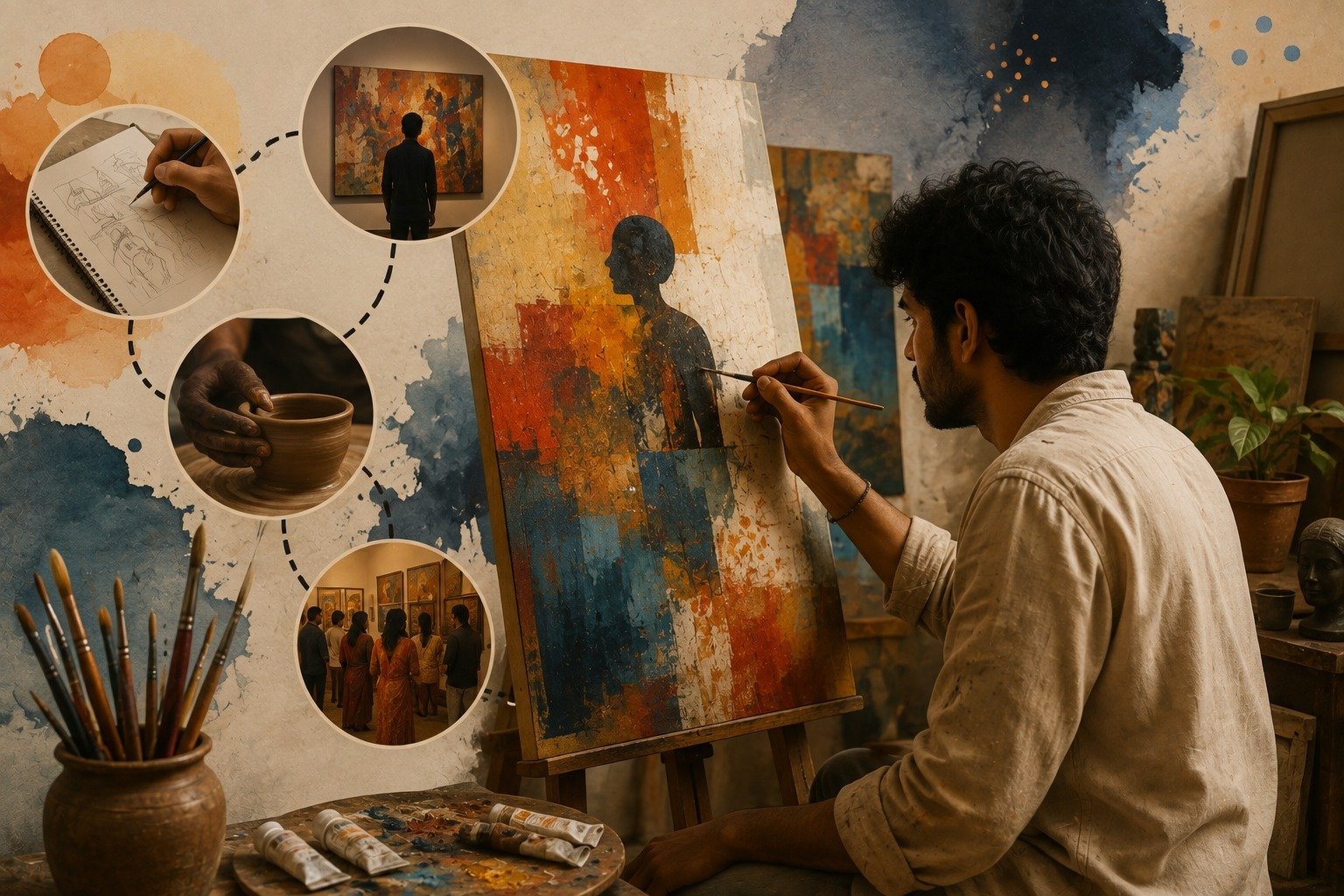
Are you ever faced with an abstract painting and feel like, ”What am I even looking at?” If so, don’t worry, you’re certainly not alone. It’s totally understandable to feel confused when confronted with abstract art; unlike a traditional landscape or portrait, there’s typically no recognisable subject matter.
But that’s also precisely what’s so fascinating about it.
Instead of dictating to you exactly what you should see, an abstract painting invites you into a space where colours move, textures sing, emotion unfolds, ideas fly and you’re invited to create a response all of your own.
What Is Abstract Art?
To simplify, abstract art breaks from realism or literal representation; instead of faithfully painting a scene from life or portrait. An artist may decide to use shapes, lines, colours,textures and forms to create a visual that has more depth to explore or communicate a concept or idea. Some abstract paintings consist of geometric shapes or clean lines and structure, while other abstract artists may use a more messy or haphazard technique. No matter how you slice it,there’s no real definition or visual blueprint to how the concept of abstract art works or where to find it.
How Is Some Abstract Art so… Different?
What makes abstract art confusing for some people is that some of its artists don’t necessarily want you to recognize anything. Instead,they may want you to ask yourselves some deeper questions exploring the art.
For instance: What emotional value do colours possess?
How can motion in a painting become tangible when there is nothing depicting motion?
How can different textures elicit certain emotions or responses when we come into contact? How can a personal feeling or memory become translated into a visual?
These types of questions need answers more closely based upon an artist’s choices then what the artwork literally represents.
Go By Your Initial Response. It counts!.
Before you can make any attempt to understand an abstract painting in some form,you don’t need to worry about answering the obvious “What is the artist trying to show?”. Instead, start with the much simpler approach. Simply ask yourself:
What first draws you into the painting? Is it a bold colour,a sharp angle,a texture you want to touch,or a large patch of negative space? What do you immediately think or feel when you look at those colours,lines or strokes in the artwork?
What do those elements evoke? Do they spark a sense of happiness,serenity,anxiety or a completely different emotion that has yet to be clearly articulated? Whatever occurs for you is a perfectly acceptable starting point in assessing the art.
Focus on Colour.
Let the colours in the painting lead the way! They’re some of the most compelling parts of the artwork,and a rich mix of colours are often designed to draw emotional reactions in the viewer. Ask yourselves: How would my mood or emotion change if this artwork contained reds and yellows rather than deep blues and greens?
What is the relationship between all of these hues on the canvas- are they contrasting, complementary,or seamlessly blending?
The interplay of colour can really convey the entire essence of a visual experience.
Don’t overlook Lines, Shapes, and Composition
Next, consider how your eyes move, turning your gaze across the painting.
How does the line work within the frame?
Are those lines rough or smooth?
Sharpor fuzzy?
The basic shapes you spot might inspire a particular feeling,and their arrangement on canvas could establish a more controlled or a decidedly uneven composition. For all intents and purposes,a truly masterful composition could lead the viewer’s eyes from place to place,without ever revealing a clear and singular focal point or a concrete reason for the layout beyond evoking the visual sensations or emotional state the artists aimed to generate.
Appreciate Textured Paint
In the rare instance you can catch one of these works-of-art from its original source material,then look to the textures; see what you could touch and feel if were given the opportunity. Even when viewed through a photograph,the ways in which thick layers of paint and rough brushstrokes were added to the canvas could reflect the creative artist. It’s really just as much about expression and process as it is about the finished composition itself,so really let those layers contribute to your understanding.
Learn a bit about The Artist
Once you’ve developed a basic impression of the artwork, you might want to find out a bit about the artist behind it.
What influenced them?
Is there an overarching theme?
Do they focus on a specific artistic technique?
Knowing a little bit about where it came from will probably help a lot – but don’t let it entirely replace your own response. Everyone experiences a given painting very differently!
You can’t go wrong: There’s only One Correct Response and it’s your own.
Most importantly,with abstract art,there’s usually no one-and-only response. You’renot required to point the hidden object hidden somewhere in there or analyze every inch of every detail. Sometimes,appreciating abstract art is all about how your eye lands upon it and what it inspires you to wonder or feel- which is the true power of the medium.
Once you start exploring,the process of viewing can become more and more fluid.
Before you know it,that lingering question, What does that paint actually mean? , will morph into, How is that painting making me feel? , and that’s where it all becomes magical.